
Google Ads pricing – How much does it still make sense to spend?
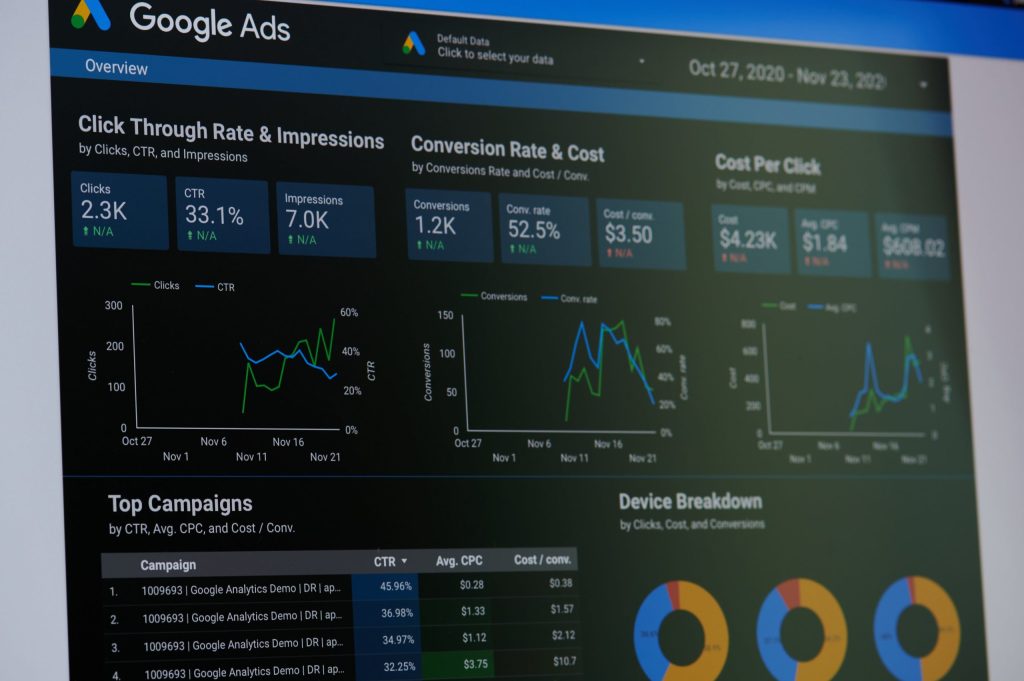
Google advertising (Google Ads) is one of the most effective tools for acquiring customers, but with rising competition and higher click prices, many people are asking: How much does it still make sense to invest in Google ads? And when is it better to allocate that money elsewhere?
In this article, we will look at:
- what the typical cost of advertising on Google is,
- which industries pay the most,
- when Google Ads pays off—and when it no longer does,
- and how to calculate a sensible monthly spend limit.
Average cost per click (CPC) in Slovenia
Cost per click (CPC) can vary by more than 1,000%, depending on the industry you advertise in and how precisely you target. For example, clicks for fashion accessories can cost as little as 15 cents, while clicks in the legal or financial sector can cost more than 5 euros. The most expensive are search terms that lead to an immediate purchase or a high-value service (e.g., a loan, a lawyer, an implant). It is also important that prices are rising—which means you will pay more today for the same number of clicks than last year.
Cost per click (Cost-per-click, i.e., CPC) in Slovenia varies significantly by industry. A few examples:
| Industry | Avg. CPC (EUR) |
|---|---|
| Construction (e.g., façades) | 0.60–2.00 |
| Legal (lawyers, divorces…) | 1.50–5.00 |
| Tourism | 0.20–1.00 |
| E-commerce (fashion, accessories) | 0.15–0.60 |
| Dentistry | 1.00–4.00 |
| Financial services (loans…) | 1.00–6.00 |
| Gambling (certified campaigns) | 1.50–10.00+ |
Click prices are lower for generic terms (e.g., “shoes”) and higher for those with purchase intent (e.g., “best shoes for trail running”).
When does Google advertising make sense?
Whether advertising makes sense does not come from CPC alone, but from the relationship between investment and return. If you get two euros back for every euro you invest, advertising pays off. But if you generate less profit per click than the cost of the clicks, you are in the red—no matter how good the ad is. That is why you need to track conversion rate (how many users actually buy), average order value, and margin. Sensible advertising is always tied to a solid understanding of the numbers.
Google Ads pays off when the ratio between costs and revenue is positive. What matters is:
- Cost per click
- Conversion rate (e.g., 1 out of 20 visitors buys)
- Average order value (e.g., €50 per purchase)
- Gross margin (e.g., 40% = €20 profit per purchase)
Calculation example:
- CPC = €1
- Conversion = 5% → 1 purchase per 20 clicks → customer acquisition cost = €20
- Average order value = €50, margin = €20
- Profit: €0
In such a case, advertising is not worthwhile—or you need to improve targeting, the landing page, or order value.
The psychological limit of a monthly budget
Every company has a point at which investing more in ads no longer brings proportionally more revenue. This is the point where the law of diminishing returns starts to show: even if you increase the budget, the cost per acquisition (CPA) rises and returns fall. That is why it is not only important how much you have available, but also how much it still makes sense to spend. Micro businesses typically test with €200–€500 per month, while larger systems invest tens of thousands of euros—but always under measurement control.
How much should you allocate per month?
It depends on:
- the value of the average customer (including lifetime value—LTV),
- the level of competition (higher CPC means higher costs),
- your ability to optimize (remarketing, length of the sales funnel, etc.).
Guideline:
- Micro businesses: €200–€500/month (testing, local targeting)
- Small businesses: €500–€1,500/month
- Mid-sized businesses: €1,500–€5,000/month
- Larger businesses: €5,000+/month
If you are spending more than your gross margin or more than 10% of sales revenue, check whether advertising has become too expensive or inefficient.
When do Google ads stop paying off?
In certain cases, Google Ads becomes ineffective or simply too expensive. If you sell a product with a low margin and a high cost per click, even a basic campaign can generate a loss. Google ads also tend to perform worse for products or services that require more explanation or personal contact. In such cases, a better approach is video content, email marketing, or SEO. If you notice that your performance worsens with higher budgets, it is time for a strategic rethink.
Google advertising is not always the right solution. Consider alternatives if:
- CPCs are so high that you no longer have room for profit,
- You are looking for long-term results (SEO, email marketing…),
- Your product needs more explanation (complex products sell better with videos, content marketing, or personal presentations),
- You want to build a brand, not just immediate conversions.
How to optimize costs?
One of the most common reasons for excessively high advertising costs is poorly set up campaigns. Often, overly broad keywords are advertised, attracting irrelevant clicks. By introducing negative keywords, better geographic targeting, and an improved ad group structure, you can quickly reduce costs and increase profitability. Landing page optimization is also important—the user who lands on the page must immediately understand the offer and have a clear conversion option.
- Use negative keywords so you do not pay for irrelevant clicks.
- Set up location targeting—reduce budget for regions with less interest.
- Run A/B tests of ads and landing pages.
- Measure the value of each keyword—not all are equally profitable.
Conclusion
Google Ads still works—but not for every industry and not for every budget. You will benefit the most if you:
- measure return (ROAS) precisely,
- understand pricing in your industry,
- and can distinguish between short-term advertising and long-term brand growth.
If it feels like you are spending too much on ads for the results you are getting, the solution is not necessarily to spend less money—it may be time to spend smarter.


